Core Objectives and Sample Proposal Responses
Purpose
The Texas Core Curriculum is designed to ensure that all undergraduate students develop the essential knowledge and skills necessary for academic success, lifelong learning and responsible citizenship.
When proposing a course for inclusion in the UT Austin Core Curriculum, faculty should demonstrate how students will achieve the required Texas Core Objectives through intentional course design, meaningful learning activities and authentic assessment.
This resource provides guidance, proposal-writing tips and examples of effective proposal responses to assist faculty in developing strong Core Curriculum proposals.
The sample responses below are intended to illustrate the level of detail expected in a successful proposal. They should serve as models for structure and content rather than language to copy directly.
The Texas Core Curriculum
The Texas Core Curriculum is established by the Texas Higher Education Coordinating Board (THECB) in 19 Texas Administrative Code (TAC), §§4.28–4.31. These rules identify the Foundational Component Areas and the required Core Objectives that must be addressed by every approved Core course.
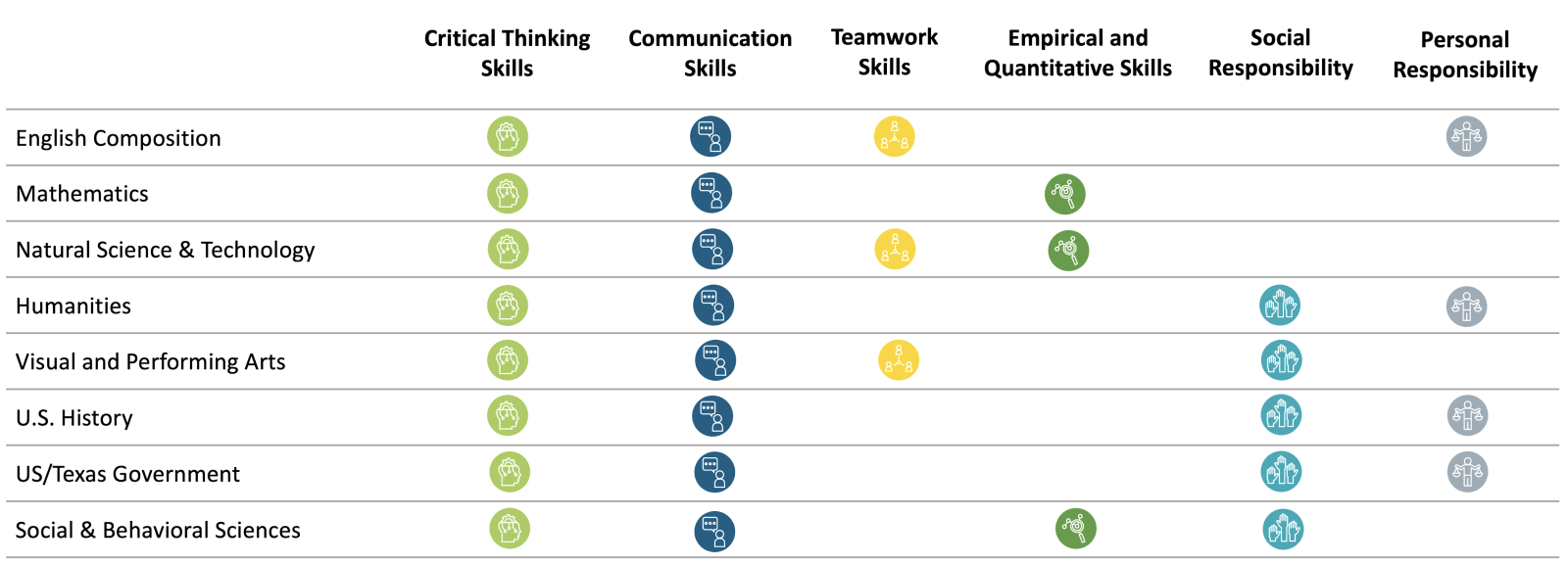
At UT Austin, proposals are evaluated to ensure they demonstrate intentional alignment between:
- The required Core Objective(s),
- Course learning activities,
- Student learning outcomes and
- Methods of assessment.
Before You Begin
Strong proposal responses answer four questions:
| Question | Reviewer Looks For |
| What assignment or learning activity will students complete? | Specific assignments, projects, presentations, labs, performances, discussions or research activities. |
| What will students actually do? | Observable student actions that demonstrate the Core Objective. |
| How will student learning be assessed? | Rubrics, exams, papers, presentations, projects, portfolios or other assessment methods. |
| How does the assignment demonstrate the Core Objective? | A clear explanation connecting the assignment to the required competency |
Tip: Focus on what students do, rather than what the instructor teaches.
____________________________________________________________________________
Characteristics of Strong Proposal Responses
Successful proposal responses are:
| Intentional | The learning activity is purposefully designed to develop the required Core Objective. |
| Observable | The proposal clearly describes what students will do. |
| Assessable | Student learning is measured using defined assessment methods. |
| Evidence-Based | The proposal identifies assignments or artifacts that demonstrate student achievement. |
| Aligned | Assignments, learning outcomes, and assessments work together to support the required Core Objective. |
____________________________________________________________________________
Writing Strong Proposal Responses
Each Core Objective below includes:
- The Texas Core Objective definition,
- What reviewers are looking for,
- Examples of weaker and stronger proposal responses and
- An explanation of why the stronger response is effective.
Critical Thinking Skills
Texas Definition
Creative thinking, innovation, inquiry, and analysis, evaluation and synthesis of information.
Reviewers Look For
- Analysis
- Evaluation
- Interpretation
- Problem solving
- Evidence-based conclusions
- Synthesis of multiple sources
| Example That Needs Revision Students will develop critical thinking skills by reading scholarly articles and participating in class discussions |
| Why this response needs revision Does not identify a specific assignment. Does not explain what students do. Does not describe how Critical Thinking is assessed. |
| Strong Example Students complete a comparative policy analysis in which they evaluate multiple policy approaches to a contemporary issue. Using peer-reviewed research and supporting evidence, students analyze competing perspectives, synthesize information from multiple sources and defend their recommendations in a written report. Faculty assess the assignment using a rubric evaluating analysis, synthesis, evidence and justification of conclusions |
| Why this works ✔ Identifies a specific assignment ✔ Describes observable student learning ✔ Explains assessment ✔ Clearly demonstrates Critical Thinking Skills |
Communication Skills
Texas Definition
Effective development, interpretation, and expression of ideas through written, oral and visual communication.
Reviewers Look For
- Written communication
- Oral communication
- Visual communication
- Organization
- Audience awareness
- Effective presentation of ideas
| Example That Needs Revision Students will give presentations throughout the semester. |
| Strong Example Students deliver a ten-minute presentation communicating scientific findings to a non-technical audience. Students organize evidence, develop visual aids and respond to audience questions. Communication is assessed using a rubric evaluating organization, clarity, audience awareness, delivery and effective use of visual materials |
| Why this works ✔ Identifies the communication task ✔ Explains student performance ✔ Describes assessment ✔ Demonstrates written, oral, and visual communication |
Empirical and Quantitative Skills
Texas Definition
The manipulation and analysis of numerical data or observable facts resulting in informed conclusions.
Reviewers Look For
- Data collection
- Data analysis
- Statistical reasoning
- Interpretation
- Evidence-based conclusions
| Example That Needs Revision Students analyze data collected in class. |
| Strong Example Students collect, analyze, and interpret experimental data using statistical methods appropriate to the discipline. Students present findings through tables, graphs and written interpretations explaining trends, limitations and conclusions. Faculty assess accuracy of analysis, interpretation and evidence-based conclusions using a standardized rubric. |
Teamwork
Texas Definition
The ability to consider different points of view and work effectively with others to support a shared purpose or goal.
Reviewers Look For
- Collaboration
- Shared responsibility
- Peer interaction
- Team decision making
- Reflection on teamwork
| Example That Needs Revision Students complete group projects. |
| Strong Example Students collaborate in teams of four to design and present an engineering solution to a real-world problem. Teams establish roles, develop a project timeline, provide peer feedback and submit an individual reflection describing their contributions to the group’s success. Teamwork is assessed through peer evaluations, instructor observations and the final project rubric. |
Social Responsibility
Texas Definition
Intercultural competence, knowledge of civic responsibility and the ability to engage effectively in regional, national and global communities.
Reviewers Look For
- Civic engagement
- Multiple perspectives
- Cultural awareness
- Community impact
- Global or regional context
| Example That Needs Revision Students learn about different cultures |
| Strong Example Students evaluate how historical events have shaped contemporary communities by comparing multiple cultural perspectives and examining the impact of public policy. Students prepare a policy brief recommending evidence-based solutions while considering diverse viewpoints and community needs. |
Personal Responsibility
Texas Definition
The ability to connect choices, actions, and consequences to ethical decision-making.
Reviewers Look For
- Ethical reasoning
- Decision making
- Reflection
- Professional responsibility
- Understanding consequences
| Example That Needs Revision Students discuss ethics during class. |
| Strong Example Students analyze an ethical dilemma within their discipline and prepare a written justification supporting a recommended course of action. Students evaluate competing values, consider potential consequences and defend their decisions using professional ethical standards and discipline-specific frameworks. |
Common Reasons Proposals Need Revision
Proposal responses frequently require revision because they:
- Describe course content instead of student learning.
- List assignments without explaining how they demonstrate the Core Objective.
- Use vague language such as “students will understand.”
- Do not explain how learning will be assessed.
- Do not clearly connect assignments to the required Core Objective.
Proposal Writing Tips
When writing proposal responses:
- Focus on what students do, not what instructors teach.
- Describe specific assignments or learning activities.
- Explain how the assignment demonstrates the Core Objective.
- Identify how student learning will be assessed.
- Use measurable, student-centered language.
- Ensure assignments, assessments and learning outcomes are aligned.
Proposal Review Checklist
Before submitting your proposal, confirm that each response:
☐ Identifies a specific assignment or learning activity.
☐ Explains what students will do.
☐ Describes how student learning will be assessed.
☐ Clearly aligns the assignment with the required Core Objective.
☐ Uses measurable, student-centered language.
☐ Demonstrates intentional alignment between the Core Objective, learning activity and assessment.
Additional Resources
Core Curriculum Proposal Workflow
Core Curriculum Review Rubric
Core Curriculum Assessment [AP1]
19 Texas Administrative Code (TAC), §§4.28–4.31 – Texas Core Curriculum